Wednesday, June 30, 2010

Summer Regards: Sweet Bird of Youth (1962)

An adaptation of the Tennessee Williams play, Richards Brooks' Sweet Bird of Youth ('62), like The Cat on a Hot Tin Roof ('58) before it, ran into some problematic production-code speedbumps in translation to the big screen yet still pulsates with that sweaty, oppressive inclination.

An essential and defining work in the career of the masterful playwright, Sweet Bird of Youth explores a good portion of Williams' trademark themes including repression, Southern authority, nostalgia and aging obsolescence.

The metaphorical title refers more specifically to the fledgling romance between Chance Wayne (Paul Newman) and the daughter of a domineering politician, Heavenly (Shirley Knight), yet it's the performance of Geraldine Page as the aging, listless former Hollywood star that leaves its stamp on the film.

Utilizing flashbacks and cold-hard marginalization, the film becomes an acute examination of love and the pursuit of fame and fortune. As Chance says himself, "the biggest of all differences between people is between those who have had pleasure in love and those who haven't."

The ending is unfortunately first-rate Hollywood smudging and unsuitably optimistic, yet at the very least it makes logical sense opposed to the quick touch-up on the end to the aforementioned film version of The Cat on a Hot Tin Roof.

Also Williams' more explicit themes are slightly hushed and inferred upon in order to slip by censors, yet the crackling dialogue and the rich, relatable and deeply inflicted characters remain firmly in tact throughout. [A-]

Summer Regards: Shall We Dance, Carefree

"SHALL WE DANCE" (Mark Sandrich; 1937)

The seventh Rogers and Astaire collaboration, Shall We Dance ('37) comes pre-loaded with as much pedigree as ever - a longer running-time, a bigger budget, a George Gershwin score - yet for all its worth, this is their first film exhibiting signs of fatigue and tedium.

Still chugging along in its adorable musical-comedy fashion, the film certainly has its moments, including "Slap That Bass", an engine-room tap routine and - if nothing else - a unique duet followed by a roller-skating waltz in "Let's Call the Whole Thing Off".

Edward Everett Horton and Eric Blore are in full form as the comedic side dishes, but this zinger of a plot involving the usual misidentification and love squabbling, is inevitable tiresome. The magic was certainly slipping a bit at this point, but for any fan of the post-jazz musical, Shall We Dance is still safely above-average. [B-]

"CAREFREE" (Mark Sandrich; 1938)

Far more of a screwball comedy than a musical, the slight and flimsy Carefree ('38) will likely bore song-and-dance aficionados and discourage sing-a-longs.

Playing a psychologist, Astaire mingles with the fragile mind of his patient (played by Rogers) who is convinced she's in love with him after a doctor-induced slow-motion dreamscape dance session.

A perky dance routine set to "The Yam" feels claustrophobic and diminished and "Change Partners", the obligatory Fred Astaire crooner, can't carry the load by itself. Even the most staunch admirers can't help but feel underwhelmed and ultimately frustrated by this lax, nutty and musically-challenged addition to the canon. [C]

Tuesday, June 29, 2010

Grits and TCM

Ate breakfast at B&J's American Cafe this morning and it was just wonderful - a nostalgic little family-owned cafe since 1940 which has just undergone a complete makeover to preserve and reinstall the look and feel of the place as it was over 60 years ago. The place is a fully functioning 50's antique diner.

They even have a massive jukebox with Elvis and Doris Day tracks on it, classic movie posters on the wall and TCM tuned in in the back. (Seriously, how great is that?) I ordered two eggs, three strips of bacon, wheat toast, American fries and a $2.29 side of grits.

Monday, June 28, 2010

No Powdered Sugar?

I ate breakfast this morning at Archie's, a local 24-hour diner just a notch beyond downtown LaPorte, Indiana (a sprawling metropolis if there ever was one). The place was full of senior citizens and Joe the Plumber's and it smelled like an ashtray with the faint aroma of toilet water, but the French Toast ($3.45) was great - go figure. (Although they didn't sprinkle the toast with powdered sugar, sad.)

I also just watched Joseph L. Mankiewicz's Julius Caesar ('53) and found it oppressively stuffy and stagey and histrionic. Sure, it's really well-acted and shot in a first-rate fashion, but who wants to watch a drab, slavish recreation of Shakespeare? I sure don't. Any movie that diminishes Deborah Kerr's presence to a mere footnote deserves a sliver of disapproval.

Summer Regards: Kiss Me Kate, Calamity Jane

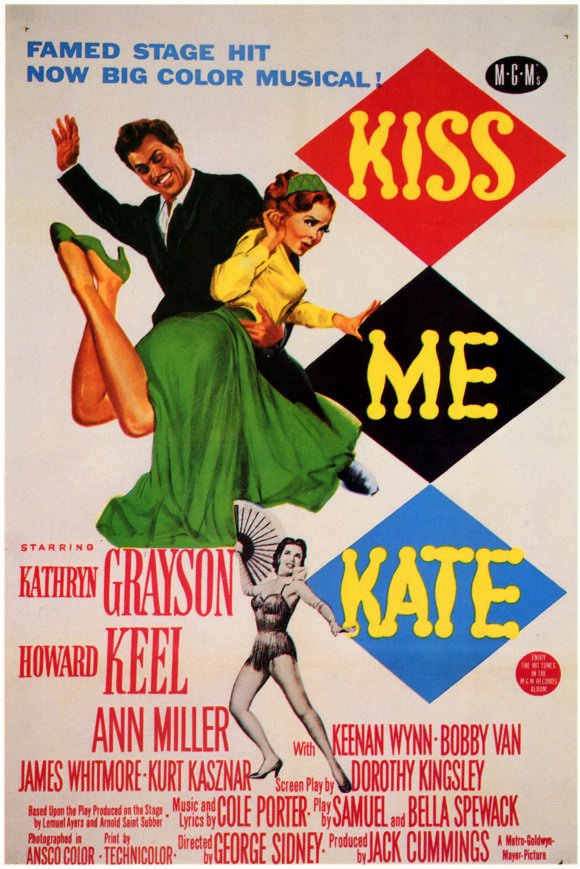
"KISS ME KATE" (George Sidney; 1953)

A mostly agreeable combination of screwball plotting and song-and-dance, George Sidney's Kiss Me Kate ('53), based on the Cole Porter Broadway play of the same name, is one of those musicals-within-a-musical that offers a backstage pass to reveal highly contemptuous romances and shoestring production.

Howard Keel and Kathryn Grayson, playing former husband and wife, are the two leads in a musical version of The Taming of the Shrew, but a mix-up involving money being owed to the mafia and a botched delivery of a bouquet of flowers, the show is in danger of losing its leading actress.

The contested relationship between Keel and Grayson soon begins to blend into Shakespeare's source material, providing both dramatic irony and genuine hilarity. Eventually, the film comes up short of greatness for the simple reason that the drama backstage proves to be far more enduring than the show being performed on it. [B]

"CALAMITY JANE" (David Butler; 1953)

A whip-crackin' western musical that's both suffocatingly perky and endearingly amusing, Calamity Jane is ultimately well-meaning mythological hokum.

Doris Day, with her masculine demeanor and her darn-tootin' Black Hills accent, is mostly a drag - dippy and irritating. Rather, it's the sweet and coy presence of Allyn McLerie as the aspiring saloon singer Katie Brown that makes the lasting impression in a performance that's both timidly sexy and surely comedic. [C+]

Sunday, June 27, 2010

Eateries, Musicals

Summer Regards: Sit, Keel!

"SEVEN BRIDES FOR SEVEN BROTHERS" (Stanley Donen; 1964)

Like a jolly, live-action Snow White, Stanley Donen's Seven Brides for Seven Brothers is a flexible, sunny, saccharine frontier-musical where high-stepping and operatic crooning is as prominent and as imperative as chopping wood.

Howard Keel plays the eldest of seven ruffian brothers who all need wives and are willing to do whatever it takes to get them, even if it means strapping them unwillingly to their backs and hauling them off to the mountains.

The musical numbers are airy and frivolous, but Michael Kidd's grueling choreography steals the show enough so as to avoid suffocating us in the film's hokey lumberjack love psalms. [B-]

"EASTER PARADE" (Charles Walters; 1948)

A delightful little rags-to-riches pink-fluttered Broadway musical, Easter Parade unites Fred Astaire with Judy Garland on the dance floor and manages to freshly approach a shopworn story about a young girl who's coaxed and transformed into a Broadway star.

Looking mostly rejuvenated, comedically on-point and far less comatose than in Vincente Minnelli's The Pirate ('48), Garland is wonderful here, with a few standout numbers including "I Want To Go Back To Michigan" and the title track, "Easter Parade".

Not considered a top-shelf classic in its genre, Easter Parade does feel marginally produced at times in the song-and-dance department, but it's another irresistibly funny and swooning love story starring - not a couple of swells - but a couple of stars in the twilight of their careers. [B+]